Insights from an aged care physician

Having the perspective of an on-the-ground practitioner who has worked in the health care profession for so many years can be instructive for us as we navigate the dying days of our lives – dying in both senses of the words, as the lights of life dim and finally are extinguished.

In: 33 Meditations on Death … notes from the wrong end of medicine, David Jarrett, reveals how to go gently into that good night. We fight tooth and nail to put off the inevitable, dreaming that medicine can work miracles, when we all know this cannot be the case, placing expectations on medicos like Jarrett that cannot be delivered in reality. These three extracts provide a glimpse into his world. They are sober reminders that people like Jarrett who work on the front line, have much to offer society, if we would only listen and pay closer attention to the facts, rather than attempting to make fantasies come true. In short we need to look death in the face and accept it for what it is, part of the rotation from one generation to another. David Jarret deserves a wider audience and the powers that be need to heed his message.

Ch 4 – Good Ageing

As a geriatrician I see mostly the wrong end of the elderly spectrum – the weakest and the most ill. Geriatric medicine has always had difficulty defining what it is. Everyone knows what a cardiologist or gynaecologist does. With geriatric medicine it’s a bit like explaining jazz. As Louis Armstrong used to say, if you have to explain it, you will never get it.

A recent proposal is that it must encompass the ‘Five Ms’, which fit neatly on the fingers of one hand.

Mind: dementia, depression and all the psychological problems of the very aged;

Medicines: all the polypharmacy, complications and side-effects of the various poisons we inflict on the frailest of the frail;

Mobility: helping to improve mobility by diagnosing the problems and managing them medically, surgically and with various therapies such as physiotherapy and occupational therapy;

Multiple complexities: the myriad age and disease-related problems that accumulate in humans with time like the barnacles on the keel of a boat; Lastly and perhaps most importantly, what …

Matters Most: that is, what matters most to the patient, which may not necessarily be going in with all guns blazing offering all the investigations and treatments at our disposal.  Page 31 and 32.

Ch 22 – The changing landscape of care

How will our health service change for the elderly? The future is already here. I am not one life’s optimists, I admit. In my view, optimism is humankind’s great self-delusion. And when I look at the future state of the health service in the UK it is easy to see it being completely swamped by demand. Although much of the demand is due to demographic change and increased life expectancy, not all of it is.

….. modern medicine seems to be focused on trying to wring the last drop of life from the already desssicated existences of the weakest and oldest in our society – of how people within a few months of death, with little chance of any meaningful extension of their lives, and no semblance of quality, are being subjected to complex and draining interventions. Just because a treatment can be done, doesn’t mean it should be done. There is a burden of disease and there is a burden of treatment, and these two need to be balanced. Interventions that can be borne by a forty-year-old may be little short of torture for an eighty-year-old. A shift in attitude towards a more traditional view of death would free the health service from its current role of overseeing the time-consuming and costly overtreatment of those with little if anything to gain from it. Medicine, and especially medicine dealing with the very old, should be about what matters most in people’s lives. This should be our priority.  Page 190-191

Ch 24 – Dying a la mode

Something remarkable will happen after your death. Not just the slow decay and conversion of your buried body unto the flesh of worms and then into the flesh of robins or blackbirds. If you are cremated, the minerals will still enter some food chain or geological cycle grinding on over millennia. What will happen is that all those grim memories others have of you, of that disoriented, crumbling, incontinent old person, will be replaced by memories of what you truly were. People will recall the good father, telling bad jokes and helping out in a crisis, the mother and friend who always showed kindness when it was needed. Just as we cannot remember pain with any clarity, those distressing memories of you in your decline will in all probability fade. This reality-denial malarkey (nonsense) must have some benefits after all. .

With the passage of time, fewer and fewer people will have any personal recollection of you. When your last grandchild dies there will probably be no one on the planet who has had any direct contact with you. If you are a great thinker, writer, actor or musician your work may last a few hundred years or a million or two. But eventually as it was for Ozymadias*, ‘Nothing beside remains. Round the decay of that colossal Wreck … the lone and level sands stretch far away.’ I, for one, take some comfort from this.  Page 208

*”Ozymandias” (/ˌɒziˈmændiəs/ o-zee-MAN-dee-əs)[1] is a sonnet written by the English Romantic poet Percy Bysshe Shelley (1792–1822). Wikipedia.

Posted in Uncategorized | Leave a comment

What we can and cannot control

Ryan Holiday regularly posts a philosophical note at The Daily Stoic. On this day he writes:

In 2021, the author Michael Lewis experienced just about the worst thing that can happen to a parent when his daughter was killed in a car accident. Asked about the grief of losing a child, Lewis first just said that it’s exhausting. “Every night I go to bed,” he said, “I’m thinking about Dixie Lewis. And every morning I wake up, I’m thinking about Dixie Lewis.” Then he added, “I can’t control that she died. I can’t do anything about that. All I can control is what her death causes, and I’m determined that it cause good things, not bad things. That’s what I’m focused on, is what does this cause? Like make sure it doesn’t cause more pain, see if it causes something else.”

The Stoics were not unfamiliar with this kind of horrendous grief. As Seneca received news of his exile, he was mourning the loss of his only child. Yet quite beautifully he channeled this pain into one of his most enduring essays, Of Consolation to Helvia, which he addressed to his mother–who herself was mourning what it would mean to perhaps never see her son again. Marcus Aurelius (see picture above) buried multiple children. He could have so easily been consumed by anger and devastation. Instead, he carried on, trying to be of service to the empire and to others.

When horrible things happen to us, our instinct is always to ask why me? Why this? Why now? It’s understandable, but it’s also irrelevant and unhelpful, because those questions have no answer. At least no answer that you can do anything about or take any comfort from. Besides, life has a better question. One it is constantly asking us, one that Michael Lewis to his credit has fully embraced: what will this cause? Will it put us out of commission or give us a new mission? Will it cause good things or bad things?

Ultimately, we don’t know why awful things happen…and there is so little we can do to prevent them. All we can choose is what we do after they befall us. All we can influence is what they cause…whether we can find a way to carry on and do good in response to what we have experienced.

Posted in Uncategorized | Leave a comment

Administration – it’s not as straight forward as it ought to be

This is a story that shouldn’t have to be told. What should be a straight forward affair once the seemingly essential paperwork is done, then people like Muriel Porter should be able to rest easy that she has done all that is required. But we can’t rely on the should word. Other people and agencies have other ideas and are not prone to giving much credence to the likes of Muriel. This is her story as posted on the ABC News website Tuesday 24 January 2023.

In: Before my husband’s death, I thought we had our affairs in order. Now I’m dealing with a nightmare of administration, Muriel writes …

For the past eight years — since my husband’s Alzheimer’s diagnosis — I have been managing all our finances.

When he was diagnosed, we had immediately set in place enduring powers of attorney and guardianship arrangements, as well as ensuring that all utilities and bank accounts were in joint names.

He already had a straightforward will, leaving everything to me, and he had always dutifully signed superannuation documents to say I was to inherit his super after his death.

Seems as if we had everything in place, doesn’t it? That’s what I thought — until he died two months ago.

I am overwhelmed now not just with grief — that is bad enough — but with a nightmare of administration.

And the worst of it is with his superannuation pensions.

Payments simply stopped.

Once the two super funds were notified of my husband’s death, the pensions simply stopped.

Yes, stopped, without any warning, without any notification. The monthly pension payments are no longer turning up.

Learn more by reading the full story HERE.

Posted in Uncategorized | Leave a comment

Authors speak about how a fear of death has played out over human history

It’s all well and good to read the book, but it’s also good to have the opportunity to her from the authors. This edition of Big Ideas from ABC Radio National provides us with that. Paul Barclay is our host.

Rachel Menzies and her father Ross Menzies, authors of Mortals

To make the most of life, it’s best to get a handle on what death might mean and how best to approach the subject not only in a practical way, but also from an historical perspective. Guests on the program delve into the deep end and help shed light on this topic in a way that helps us better understand where we fit in and how we might use this knowledge to ease us along the path from our current place to what will be our ending of days.

The producers of the program write: Make the most of your life and be at peace with death. Easy to say but hard to do. Death is not a topic we’re encouraged to talk about but its shadow shapes many of the things we do.

Mortals: How the fear of death shaped human society recorded 10 March 2022 Adelaide Writers Week

First broadcast 31 March 2022. Rebroadcast Thursday 12 January 2023.

Speakers

Rachel Menzies-Author and Postgraduate Fellow University of Sydney

Ross Menzies– Author and Professor UTS Graduate School of Health

Rick Sarre-host-Adjunct Professor of Law and Criminal Justice University of South

Listen here.

Posted in Uncategorized | Leave a comment

Keep in mind that the end could come at any time

There is a philosophy as old as the hills. Well not that old. Two thousand five hundred is not in the millions which is the age of the hills, but it’s a long time in human history.

So it is that we begin the year with a quote and some wise words from philosophers who’ve been in the business of thinking about many of the things we think about, long before we started to think about them. This post comes courtesy of a project run by Ryan Holiday, titled The Daily Stoic. Here are his thoughts for Monday 9 January under the heading “Remember that you will die”.

Let us prepare our minds as if we’d come to the very end of life. Let us postpone nothing. Let us balance life’s books each day. … The one who puts the finishing touches on their life each day is never short of time.” — Seneca

The powerful and the wise have been finding ways to remind themselves of their mortality for centuries. Their art is filled with it. Their writing muses over it. Their desks were staged with totems to remind them of the urgency of life. They would keep reminders close to their body too, wearing memento mori rings, cufflinks, even tattoos. They never wanted to forget: We can go at any moment.

The Stoic finds this thought invigorating and humbling. Remembering this fact is one of the most important and critical of Stoic exercises.

It is not surprising that one of Seneca’s biographies is titled Dying Every Day. After all, it is Seneca who urged us to tell ourselves “You may not wake up tomorrow,” when going to bed and “You may not sleep again,” when waking up as reminders of our mortality. Or as another Stoic, Epictetus, urged his students: “Keep death and exile before your eyes each day, along with everything that seems terrible— by doing so, you’ll never have a base thought nor will you have excessive desire.” In Meditations Marcus Aurelius wrote “You could leave life right now. Let that determine what you do and say and think.” That was a personal reminder to continue living a life of virtue NOW, and not wait.

The French painter Philippe de Champaigne expressed a similar sentiment in his painting “Still Life with a Skull,” which showed the three essentials of existence – the tulip (life), the skull (death), and the hourglass (time). The original painting is part of a genre referred to as Vanitas, a form of 17th century artwork featuring symbols of mortality which encourage reflection on the meaning and fleetingness of life.

This is only depressing if you miss the point. Used properly memento mori is a tool to create priority and meaning, one that generations have used to create real perspective and urgency. To treat our time as a gift and not waste it on the trivial and vain. Death doesn’t make life pointless but rather purposeful. And fortunately, we don’t have to nearly die to tap into this. A simple reminder can bring us closer to living the life we want.

Holiday doesn’t beat about the bush. He is rather blunt leaving his readers in little doubt about the nature of his subject for the day. It fits with our position that states we need to face up to the realities of what it is to live in the present, knowing that this present day could be our last. It will be for thousands of people whether they have planned for it or not.

Let’s make sure as Seneca says that our minds are prepared for whatever eventuality life sends our way. “The one who puts the finishing touches on their life each day is never short of time”.

Posted in Uncategorized | Leave a comment

Return to the earth as a tree

In:What Tree Will You Be When You Die?, Georgina Reid (Wonderground 26.11.2019), she speculates on the various options available to us when we die if our wish is to be a little closer to the earth than is normally the case.

Writes Georgina …

When I die, I want to be a tree. I’m not fixed on a particular species – I’d be happy to be a she-oak like the ones on the banks of the river near my house, or a yellow box from the farm of my childhood. I’d also be fine to be a banksia or an angophora. As long as my body is offering itself to new life, I don’t mind. I mean, I won’t mind, because I won’t have one.

One thing I do mind is the way I go. No funeral parlour, no horrible MDF coffin, no embalming, no city cemetery. I want to simply return to the earth and help something else grow. I’m not alone. The movement towards natural death practices is growing rapidly (ha!) due to the economic and environmental costs of common funeral practices, and a desire to re-connect to rituals around death. Green funeral directors, death walkers, coffin-making clubs, death cafes, and even mushroom burial suits are part of a return to a more connected vision of death and dying.

The full story here.

Posted in Uncategorized | Leave a comment

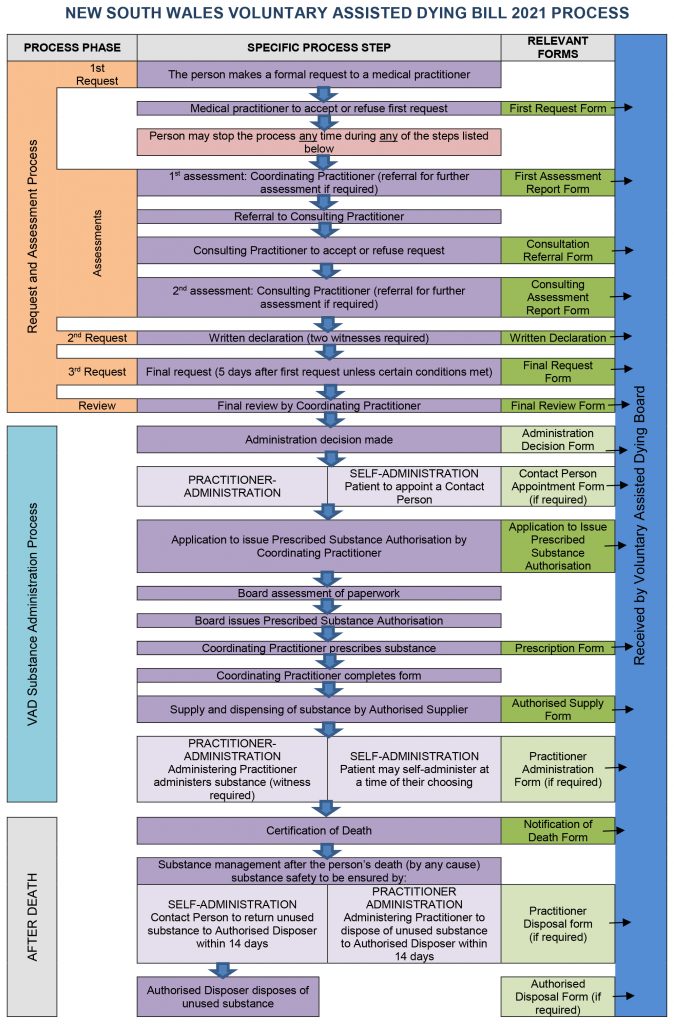
Voluntary Assisted Dying Bill – the process

The new VAD laws for NSW won’t come into effect for another 12 months – November 2023. When they do, how will they be applied? What will be the process for accessing them? Here is a flow chart of the process that potential users will need to follow …

Posted in Uncategorized | Leave a comment

A tower of strength for nature dies at 84

It’s been a sad day for us at Die-alogue Cafe. We have learned that Herman Daly the father of ecological economics died on 28 October 2022. He was 84.

Tributes have been posted in newspapers and online around the world. Herman was one of the first to shine a light on the inconsistencies contained within classical economic theory. Trouble is, this theory has taken hold in the minds of powerful interests who have and continue to use it as the basis of economic practice. He said in response to this way of thinking – that is in denial when it comes to acknowledging that the earth is the source of all our social and financial actions – that we are all now trapped within the clutches of exploitation and waste – treating the earth as if it were a business in liquidation.

We can’t hope to capture the full extent of Herman Daly’s contribution to challenging the status quo. We can however, provide you with some references for further reading.

In: The inconvenient truth of Herman Daly: There is no economy without environment, Jon D.Erickson, Professor of Sustainability Science and Policy, University of Vermont (11 November 2022) writing The Conversation, said: Herman Daly had a flair for stating the obvious. When an economy creates more costs than benefits, he called it “uneconomic growth.” But you won’t find that conclusion in economics textbooks. Even suggesting that economic growth could cost more than it’s worth can be seen as economic heresy.
https://theconversation.com/the-inconvenient-truth-of-herman-daly-there-is-no-economy-without-environment-193848
………………………………….

We mourn the death of a giant
Herman Daly, co-founder of the discipline of ecological economics, champion of the steady-state economy and a long-time voice for sanity on population. We add our praise to the chorus.
The Overpopulation Project, 8 November 2022
https://overpopulation-project.com/herman-daly/
……………………………

Herman Daly Challenged the Economic Gospel of Growth https://www.nytimes.com/2022/11/08/business/economy/herman-daly-dead.html

Herman Daly never gave up working for what he believed to be in the best interests of the children of the future. He talked about planting a seed from which future generations might find inspiration to build on the knowledge he had gained.

Herman Daly might be dead as a physical body but his ideas and those who came to know and work with him, who are still living, will build on this, and continue to build the framework for a more just human understanding of how things really work in nature. We must copy and mimic how the biosphere behaves and by extension put these into practices, passing them on to our children and those who follow.

Posted in Uncategorized | Leave a comment

To die of old age – something you can’t do in NSW

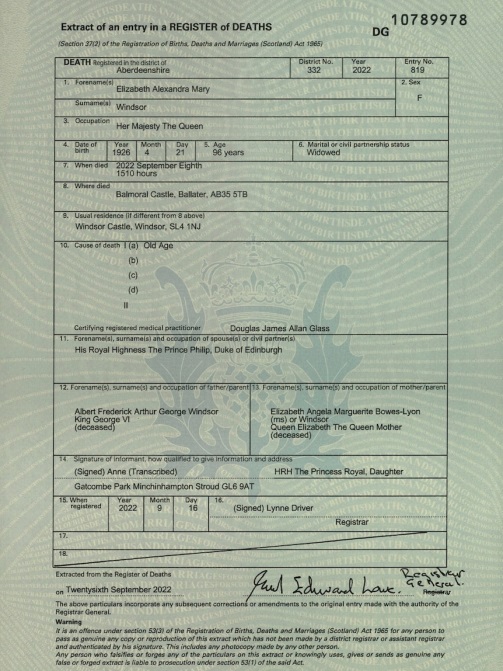
It’s official. Elizabeth Alexandra Mary Windsor, the late Queen of the UK has died of old age. We know so, because that’s what is stated on the Death Certificate at item 10: Cause of Death: Old Age.

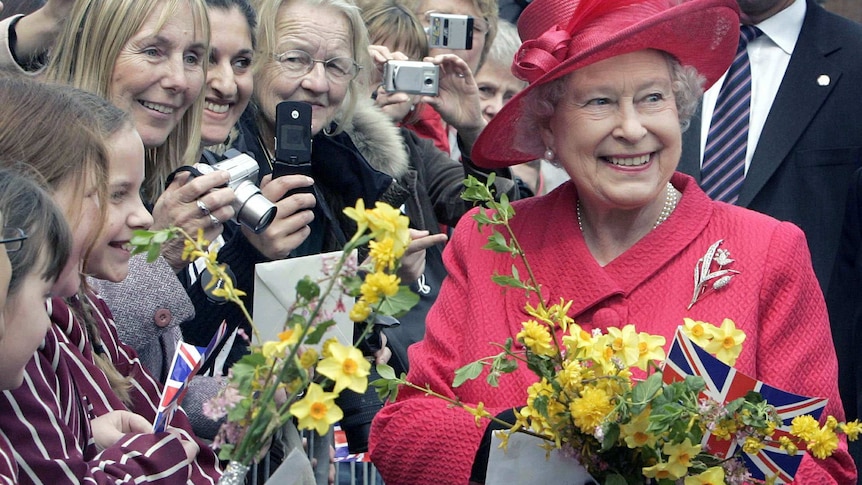
Queen Elizabeth II died on September 8. (Reuters: Kirsty Wigglesworth)

Good on the Brits for retaining this description, because it has been taken off the list in NSW. With the medicalisation of our ending of days, we have to die of something like a heart attack or cardiac arrest or the failure of some other organ in the body.

For centuries, people have died of old age, and still do. But now in these times of co-morbidities, we die of multiple causes of which one will get the nod and be recorded on the Death Certificate, regardless of whether it was old age, which for many elderly people will be the case.

According to a story posted on Friday 30 September, Queen Elizabeth II’s death certificate says the monarch died of ‘old age’.

A photo issued by the National Records of Scotland, shows the death certificate of Queen Elizabeth II. (AP: National Records of Scotland)

The country’s longest-reigning monarch died peacefully, at the age of 96, at Balmoral Castle, her summer home in the Scottish Highlands, on September 8.

And the certificate recorded her time of death as 3:10pm — three hours before her death was publicly announced.

The Queen, who spent 70 years on the throne, had been suffering from what Buckingham Palace had called “episodic mobility problems” since the end of last year, forcing her to withdraw from nearly all her public engagements.

Her certificate of death was registered by her daughter, Anne, The Princess Royal, on September 16.

Read the full story as published by the ABC at this link: Death Certificate says Queen died of ‘old age’.

Posted in Uncategorized | Leave a comment

Getting on with it – for the sake of those who come next

Here we go again. Another report that tells the same old story of Australians not getting on with getting properly prepared for their end-of-life trip.

Report by the GroundSwell Project 2022

Rather than go on with another notation of why we need to pay attention to our aging and our future frailty that will eventually lead to our ending of days, we simply provide a link to the latest report that contains this information we all need to be aware if we are to be sufficiently informed about where we are at as a society .. for instance 35 per cent have got it done, 28 per cent are thinking about getting it done, while almost a third, 31 per cent are not intending getting their affairs sorted any tine soon.

What’s the best time to get our stuff sorted? Ten years ago. Five years ago. Twelve months ago. Last week. And the next best time is now. All we can do is send a message and urge us all if we haven’t done so, is get on with Getting Dead Set.

Report by the GroundSwell Project prepared for Dying to Know Day 2022.

Posted in Uncategorized | Leave a comment