The town with a community operated funeral service

Funeral scene, Back Rds LR, ABCtv 11.18.docxWhat to do when the closest funeral provider is an hour away, when local residents can’t afford the expense of the commercial operators?  Tough bikkies, is what some people would say, but not a town that is known for its can-do approach to life.

And so it is, for 20 odd years Lightning Ridge, in northern NSW, has applied the can-do attitude to one of the greatest essential services that any community can provide – a funeral service. That it is of the people, by the people, for the people, makes it an outstanding achievement and an example of what can be done when others shy away or turn up their noses. As if to say that this is unpalatable or not normal.  It was once not only normal it was expected of everyone to be involved in farewelling those who had died. Done in-house, there was no outsourcing like we do today.  Needless to say, it cost next to nothing.

It was during the opening scenes of the ABC-tv program Back Roads with Heather Ewert (10-12-2018 and later on iView) that we find out how the Lightning Ridge community under the guidance of Mayor Ian ‘Woody’ Woodcock, do funerals with down to earth panache – nothing overly fancy, but with genuine respect and dignity as a given.

We have transcribed the spoken portion of the program here.

Lightning Ridge Funeral Advisory Service (LRFAS)

Time: 2:00 – 2:40 opening segment, then 2:41 – 5:00 min

Featuring – Ian ‘Woody’ Woodcock, Mayor, Lightning Ridge and President LRFAS

HE: I’ve got to ask the obvious question – what are we doing in a hearse?

IW: Lightning Ridge has always been a do-it-yourself community – we do our own funerals – most things are done by the community …

HE: Woody is taking me to the centre of town and would you believe it, we’re going straight to the morgue …

IW: This is where the work room is …

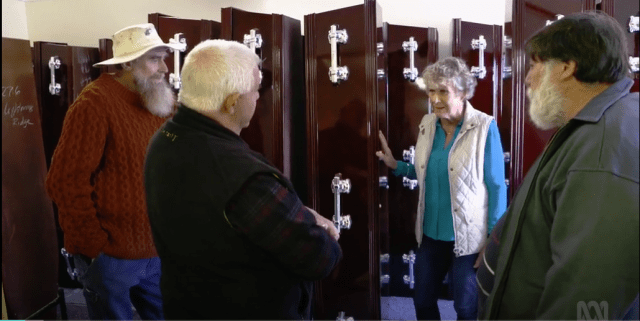
HE: Oh my God – what a work room … (Display of coffins)

IW: Pick your box …

HE: The nearest funeral director is an hour away in Walgett, so Lightning Ridge decided to set up its own funeral service, run by volunteers, Ormie Molyneux (OM) an Opal Miner and Tommy Urqhart (TU) the town’s retired butcher … how did you get roped into it?

OM: One of my uncles was a co-founder and we just tagged along for the ride …

HE: How about you Tommy?    TU: I was dragged in by Ormie …

IW: They just came to give us a hand – we didn’t say what for …

TU: After 38 years being a butcher, nothing really shocks me …

HE: It must be really hard because you must know most of the people that you’re burying?

IW: Yes, that’s probably one of the good things about it …

TM: It’s easier for the families – we all know each other – they feel more comfortable with us rather than the undertaker with the top hats ‘n’ tails …

HE: These men carry out about 20 funerals a year – all up they’ve buried 550 people – even built their own fridge … (Morutary with fridge)

IW: It used to be housed down at the Lions Park until we built the morgue here – they used to keep their beer cold in it, so that’s good news – so that’s what it was used for …

HE: I don’t believe it …    OM: A very versatile fridge …    HE: There’s nothing in there?

IW: No one’s in there – it’s run at 0 degrees all the time …

HE: And you actually have to prepare the bodies and dress them – you do that to …

IW: If we have to – if a family request that we dress them and do their make up or whatever the case may be .

HE: Do make up? Seriously?    IW: Yes we do …    HE: Who taught you how to do make-up?

IW: I used to watch my wife in front of the mirror …

HE: Well that’s got to be a first …..

Later … after hitching a ride back to Lightning Ridge ..

24:45 – 25:45

HE: I find ‘Woody’, Ormie and Tommy out at the cemetery – the town’s oldest resident has died at the age of 100 – there’s sadness of course – but also a celebration of a life well lived in Lightning Ridge  [Grave marker inscription:  RIP  Peter Verkroost – 26.12.17 – 15.7.18]

IW: A very good innings when you can reach 100 years – he got a letter from the Pope, a letter from the Queen, a letter from the Prime Minister – so he was thrilled …

HE: Some weeks this trio have to help bury 2 or even 3 of their friends.  Lightning Ridge is lucky to have them.

And a story that appeared in the SMH 22 June 2016.  Lightning Ridge volunteers bury the dead in town with no undertaker

Posted in Uncategorized | Leave a comment

When loaf takes on a new meaning

Coffin bread, spinach dipEvolution is not only confined to the biological world, there is evolution within language as well. Who would have thought that the humble loaf would have anything to do with our discussions about dying and death?
In The Story of English in 100 Words, David Crystal explores how words have evolved from times past and how they fall in and out of favour. Loaf is still in vogue but this is not so with all the associations that have been attached to it.

When we think of loaf the first thing that comes to mind is a loaf of bread.  From this connection with food we get a connection with money as in breadwinner and we get the connection with our state of mind, knowing on which side ones bread is buttered on and level of achievement, the best things since sliced bread.

Continuing on down through the ages and we have different kinds such as white loaf and brown loaf, loaf tin and lately mini-loaf; today there is the meat-loaf and so on it goes.

“But nobody could have predicted the 20th century use of loaf in Cockney rhyming slang.  The popular sounding loaf of bread replacing head. It soon reduced to simply loaf, especially in the phrase: Use your loaf, meaning ‘use your common sense’ “, writes David Crystal.

To top off our discussion we find that one usage had loaf of bread replacing dead.  “You can find it in Auden and Isherwood’s play The Dog beneath the Skin (III.iii.123):                   Oh how I cried when Alice died, The day we were to be wed! We never had our Roasted Duck, And now she’s a Loaf of Bread.”

In the new year we will continue to post stories about how the use of words relating to dying and death have been around for centuries.  That we tend to shy away from using the D-word does us no good.  We will continue to ‘expose’ all manner of D-words ‘going forward’  as the jargon would have it.  Suffice to say that in doing a spot of research for this post we came across many images for coffin bread as it is called in many Asian countries. Another subject to explore in coming months.


Posted in Uncategorized | Leave a comment

When the coffin becomes a tourist attraction

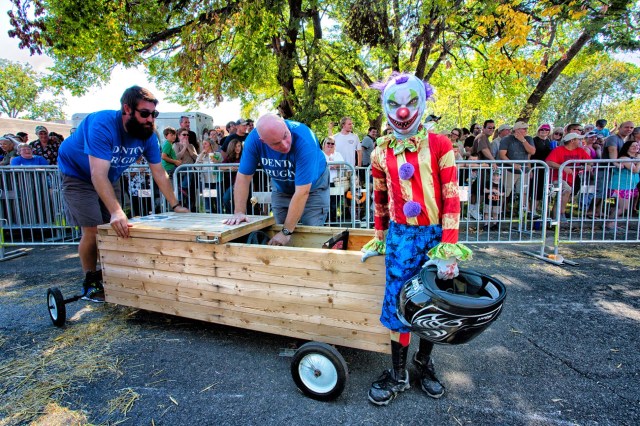
Bizarre, ridiculous, crazy, disrespectful, commercial madness, tourism gone too far.  However you like to describe it the coffin races at Manitou Springs, Colorada are something to be seen to be believed – at least for those of us not used to such antics.

The 2018 event was held on 27th October and attracted a large number of entries. The race is held to honour Emma Crawford, “a young woman seeking the mineral springs “cure” from tuberculosis. Emma came to Manitou Springs in the 1800’s. Sadly, Emma passed away in 1890. Before passing, Emma asked her fiance to bury her on top of Red Mountain. Her wish was honored, and her remains rested peacefully atop the mountain until 1912. During the early 1900’s, the Louisville and Nashville Railroad Company began building an incline to the mountain top, forcing her coffin to be moved. She was reburied on the south slope of the mountain. After several years of rain and harsh weather conditions, Emma’s remains slid down the mountain into the canyon below, where two young boys found her name plate and the silver handles from her casket.

Manitou Springs, in honor of Emma Crawford, celebrates this fun and crazy event of the Emma Crawford Coffin Races and Festival, now in its 24th year.  Up to 70 teams compete in the races.  For more: Emma Crawford Coffin Races

A similar event is held at Denton on its annual Day of the Dead Festival.  For more: Denton Day of the Dead Festival

Denton DoDead Coffin race entrant1

Posted in Uncategorized | Leave a comment

Mere Mortals on stage

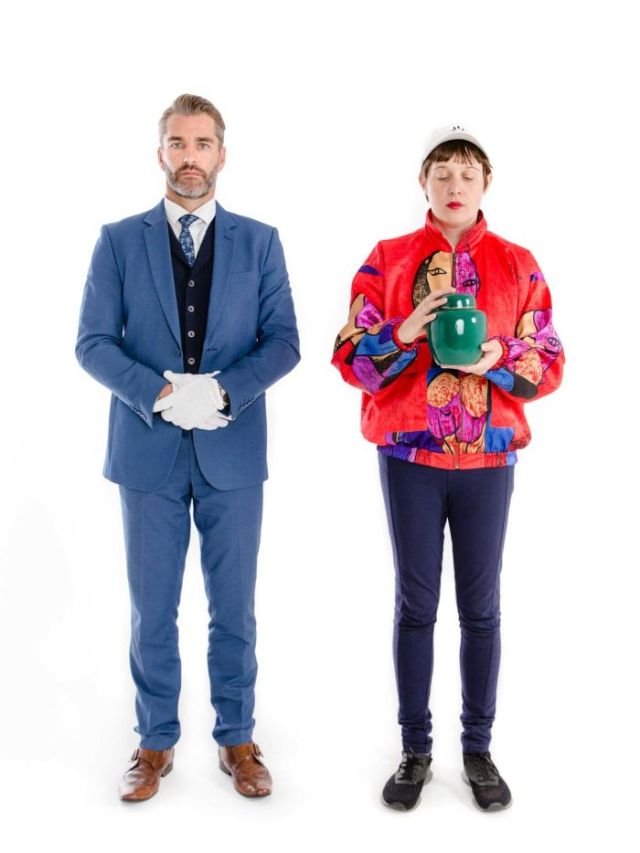
The Direcor, 10511232-3x4-largeA former undertaker and an artist get together to present a delightful take on the subject that many people shy away from.  Let’s hope this continues to demystify the D-word in all its manifestations. The Director is one of two shows playing at the Art House, North Melbourne Town Hall, Victoria.

Mere Mortals is the working title for two plays focusing on the concept of morality, living, dying, and everything in between.

“Across museums, film – and even in our own state legal system’s changes towards dying with dignity – death is a hot subject right now,” said Arts House Artistic Director, Emily Sexton.

“Yet in an increasingly secular Australia, it remains a taboo and shocking event. Mere Mortals sees artists explore this topic from a range of angles through a series of informative and expansive works designed to illuminate the darkest times,” said Sexton.

Die! Die! Die! Old People Die! is a simple but paper-fine portrait of a timeless trio: a love triangle cursed to eternal life without eternal youth, in an age where death and the forgotten art of grieving have been medicalised out of existence. Flagship UK theatre company, Ridiculusmus (The Eradication of Schizophrenia in Western Lapland; Give Me Your Love), returns to Arts House to reclaim humankind’s last taboo from its imminent eradication. Indie theatre legends, David Woods and Jon Haynes project into 120-year-old versions of themselves in a seriously funny work about hanging on, dying and grieving, played at 33rpm. Amid fumbling, daily rounds of coffee, call centres and cat food, their rants, dribbles, pills and cough bombs litter an ambling blend of symbolist mysticism and synesthesia that has the fear of an ageing population in its sights and oozes with the positivity of elderhood and good deaths.

The Director is a bold new performance starring charismatic ex-funeral director of 21 years, Scott Turnbull, and artist Lara Thoms. Taking up a universal experience and taboo topic, Turnbull and Thoms demystify, expose and expand elements of the death industry, using humour and first-hand knowledge to dig a little deeper on what happens after we go. Nothing is off limits, including the smell of a crematorium, the tools of the mortuary, and driving tractors into a funeral chapel. At a time when dying costs an average of $10,000 and funerals happen within a week, death can seem like a very expensive drive-thru meal.  Blurring the roles of funeral director and theatre director, Thoms and Turnbull ask each other to perform tasks, share knowledge and give feedback on each other’s actions. Balancing macabre reality, playfulness and the tragic elements of death, the result is a spiky, funny and invigorating performance.

Die! Die! Die! Old People Die! –  20–25 Nov 2018; The Director  –  21 Nov–2 Dec 2018

Arts House, North Melbourne Town Hall, 521 Queensberry Street, North Melbourne
Tickets$25 – $35 (plus transaction fee)


Posted in Uncategorized | Leave a comment

Nature inspired grief relief

There’s the death of the person who has died and there’s the death space that is left within those who remain behind to grieve.

When Dr Ross Dyer died, his daughter Jo Dyer came to terms with it by doing what many people do, return to their place of origin – nature. In her case it was the garden.

In this story by Melinda McMillan: Nature at the heart of art born from deep grief (The Star, August 15, 2018) we find that the peace found within, is expressed outwardly through art inspired by nature.

“My father was a big nature lover, he loved the bush and he loved the beach,” Dyer said. “He was quite adventurous and was passionate about nature and connected to nature.
“It might sound strange, but I think he died the way he would have preferred to die doing something he loved, out in the waves.
“Following his death I felt this intense desire for solitude.
“I did spend time in the studio but felt this intense need to connect with nature. I did that through gardening.
“I started sitting in my garden and drawing my plants from life and actually creating some of the works in my garden.”

The exhibition is a fundraiser for Global Gardens of Peace, an organisation that creates green-spaces for disadvantaged communities.

“It’s an Australian charity … starting with a project in the Gaza Strip,” Dyer said.
“One of the founders went there and saw children playing in the rubble and went and visited a cemetery – it was literately the only green-space in the community.”
Read the full story here:  https://www.newcastlestar.com.au/story/5577721/nature-at-the-heart-of-art-born-from-deep-grief/

  Artist Jo Dyer

View some of the art here:  https://www.gallery139.com.au/2018-exhibitions/jo-dyer

Posted in Uncategorized | Leave a comment

Recompose your thoughts for this one

Recompose, fallen+log+cropped+-+labeled+for+reuse.pngThis is a good news story that we hope comes to fruition – literally bears fruit of the earthly kind. While it is all taking place in the United States, it is great to know that good people are working to bring about change in an area that desperately needs it.

First, a bill to legalise recomposition has been drafted and will be introduced during the January 2019 Washington State Legislative Session. The team at Recompose has been meeting with lawmakers all over the state, and it’s been fantastic to hear their support for this environmentally-aligned death care choice.

Second, the group is wrapping up a research pilot with Washington State University, and the results have been excellent.

Recomposition has been proven safe and effective; it’s a natural and gentle way to return our bodies to the earth. We look forward to sharing the official results with the Recompose community in the next few weeks.

To learn more and find out who is behind this venture: Recompose for a gentler way of returning to the earth

Posted in Uncategorized | Leave a comment

Being allowed to die of natural causes

Researchers at the University of NSW are calling “for restraint on the use of aggressive life-saving treatments for frail elderly patients at the end of their lives, saying the focus should instead be placed on making patients’ last days comfortable and dignified.”

This is not the first time such calls have been made along these lines.  Professor Ken Hillman has been advocating for a more patient centred approach for years.

A/Professor Cardona said that hospitals and emergency staff were offering invasive treatment when a close look at the patient’s history would suggest a gentler approach could be more appropriate.

She said these often-costly and aggressive treatments bring about unnecessary suffering for patients by admitting them to the ICU, and questioned the benefit to the patients, their families and the health system.

Half of the deaths in the study occurred within two days of the medical emergency call, while all patients with a not-for-resuscitation order died within thre months. A/Professor Cardona said this suggests the prognoses of the patients would have been somewhat predictable.

“Our findings strongly indicate that admission to the ICU and invasive procedures for elderly people dying of natural causes need reconsideration,” A/Professor Cardona said.

“When death is inevitable, other more appropriate pathways of care can be offered such as symptom control, pain relief and psychosocial support.”

For the full story: Call for restraints on end-of-life treatments

Posted in Uncategorized | Leave a comment

How one family dealt with the experience of extinction

It was back in 1975 that Robert Pyle gave a name to a phenomenon that was becoming more common as our cities grew larger and their citizens were increasingly distanced from having any experience with the natural world.  The “extinction of experience” wrote Pyle breeds apathy towards environmental concerns and inevitably degradation of the common habitat that we all depend on. The loss of human-nature interactions has come at a price.  From an end of life perspective, what was once seen as normal has been replaced with denial and fear and from a planning ahead standpoint, procrastination.

This story about a very ordinary event has an authentic ring about it. Amanda Blair reports in Farewell furry friend (Australian Women’s Weekly, September 2018, page 94), that it was early one morning when her son found his pet guinea pig Jack, dead.

While this was the extinction of Jack, it was an event for the family that allowed for the process of dealing with death to be experienced first hand.  And it is interesting to see what happened.

“I dug a grave near the lemongrass bush because this was Jack’s favourite spot  … My son wasn’t prepared to put Jack in the ground immediately.  He needed time to say his proper goodbyes before he went one foot under.  Respecting his need for closure, a shoebox filled with straw became a lovely coffin …. The neighbourhood kids came around for open shoebox viewings and to pay their last respects and after seven days I told my son to say goodbye to the goodbyes – it was time to let him go,” said Blair.

This is the gist of the story.  It’s one that is lacking in many households as high rise and apartment living take over from rural settings and the suburban block.  While this brief note refers to the human-nature experience it applies also to the human-death experience.    Extinction of experience – a brief note


Posted in Uncategorized | Leave a comment

Sounds confronting but it is actually very fitting for our times

The title sounds confronting but be assured the message comes from a comforting place.  While Sallie Tisdale doesn’t shy away from the hard content that some can find disturbing, there is much to recommend this book.  Advice for Future Corpses (and Those Who Love Them): A Practical Perspective on Death and Dying.

There’s no doubt about it we are, like it or deny it, future corpses, plain and simple.

Tisdale reminds us that, while it might appear many things go on forever and could be described as being ‘permanent’, she says, “Impermanence is the key to our pain and our joy.”  She calls on Buddhist philosophy by saying, “Why should you treat yourself in a special way? … When you understand birth and death as the birth and death of everything – plants, animals and trees – it is not a problem anymore.”  Finding an acceptance of this reality is therefore comforting. This way of thinking allows us to live out our remaining days, be they 80 years or 8 months, with a greater sense of purpose.

“Our lives, as we live them day by day, create the person we will be at the moment of death … you see it in the way a body rests or fights, in the lines in the face, in the faint shadow of a smile or a scowl, worry or peace.  With every passing day we create the kind of death we will have.”

Tisdale reminds us that scientists have made great advances in overcoming many infectious diseases and as a result, community beliefs have changed such that many people believe you can delay death forever; but it’s not true.

Rather than seeking out a ‘good’ death, Tisdale suggests we might be better off thinking of a ‘fitting’ death. (p.49)

What this is all leading up to is an acceptance that we can’t ‘fix’ dying.  We can make plans but when death decides to visit then that’s what happens.

In Chapter 10, Bodies (page 155), Tisdale points out that you don’t have to do any of the traditional things promoted by the commercial funeral industry.  An increasing number of people are finding that they are able to take care of business themselves.  These would include:

  • “You can take the body to a mortuary or crematorium by yourself. People have been known to dress a body and strap it into the passenger seat with a rakish hat for the ride.”
  • “You don’t have to have funeral.”
  • “You don’t need to use a hearse or a coffin.”
  • “You can speak to cemeteries and crematoriums directly and prepare the body yourself.”
  • “You don’t need pallbearers but the reason six strong men may be required is the coffin. Most bodies can be carried by four women.”
  • “Shrouds have handles for carrying purposes.”
  • Good sources of information are the Natural Death Care Centre, Byron Bay and the Groundswell Project, Blue Mountains, NSW.

This might sound like a strange or left of field comment but under English common law no-one owns a dead body and a dead body owns nothing: “the only lawful possessor of a corpse is the Earth.” And when you think about it, how could it be any other way?  So if you want to know what to do with a dead body, don’t start by asking a conventional funeral provider; start with a Civil Celebrant or one of the two organisations mentioned above.

Turning to page 171, Tisdale addresses the challenge we are now faced with: our population size and how we are going to deal with the inevitable number of corpses in the coming years.

Do we want to follow in the footsteps of the vertical cemeteries that exist in several countries? The tallest is Brazil’s Necropole Ecumenica in Santos; fourteen stories tall with 25,000 burial units.  “It’s one of Santos’ most popular tourist sites with a snack bar on the roof and peacocks in the gardens. But Tisdale points out this is not a cost effective burial; a three year rental can cost tens of thousands of dollars. The three year period reflects the typical decomposition time after which the families have the remains removed to a cheaper place.

After death choices – what’s it all about?  The word cemetery comes from a Greek word meaning, ‘a sleeping place’.  Maybe this would help us think about other ways to put our loved ones to ‘rest’ and so on page 173 we learn about the Recompose project in Seattle, USA, its purpose being to recover our physical remains as a kind of fertile soil for use in parks and landscapes.

There’ s no doubt about it, this is a wonderful book. It’s another example of the reality that there are always new insights to be gained from seeing the world with new eyes.  There are four appendices in the back of the book: Preparing a Death Plan; Advance Directives; Organ and Tissue donation and Assisted Death.

For more: https://www.goodreads.com/book/show/36373274-advice-for-future-corpses-and-those-who-love-them

https://www.smh.com.au/entertainment/books/advice-for-future-corpses-review-sallie-tisdales-guide-to-facing-the-end-20180628-h1207j.html

What the Living Can Learn by Looking Death Straight in the Eye, Parul Sehgal. June, 2018

https://www.nytimes.com/2018/06/26/books/review-advice-for-future-corpses-sallie-tisdale.html


Posted in Uncategorized | Leave a comment

People need to die, says funeral planner

It is a funny business, the funeral business, if you’ll excuse the use of the phrase.  Because of the milder weather there have been fewer serious colds and influenza events and this has led to fewer deaths.  Bad news if your main client base is families shopping for a funeral provider.

This story by Emma Koehn: ‘We need people to die’: funeral businesses worry about slowdown in deaths (SMH Business section 18 August 2018) demonstrates once again how the commercalisation of dying and death has become big business with profit margins impacted when we citizens don’t ‘play the game’ according to the number crunchers within a product based industry.

Says Koehn: Australia’s funeral businesses are facing a difficult truth: not enough people are dying. To be more exact, vendors are saying numbers point to “softer” market conditions in recent months – meaning a drop off in death that hasn’t been great for business.

While the bigger companies are experiencing a drop off in numbers, one of the reasons is because there are more businesses opening and offering more choice.  It’s hard to keep on top of the jargon used within the funeral industry but one of them is “cookie cutter” funeral options. This is a way of describing the one size fits all, standardised product offered to families.  Often sold on the bases of price, it has meant that smaller companies are entering the market to provide more personalised funeral ceremonies at the same or cheaper prices.

We would hasten to say that all this ignores the fact that we can take charge of our own final disposition without calling in the services of strangers and external providers. What is made to sound complicated and beyond our ability is absolutely doable and well within our capacity to deliver. None of this would make the business pages.  Death has become big business.  Death needs to be reframed with final farewells being proportionate to the situations encountered at the time of death. In many instances the would then be not only respectful, dignified and family friendly. They would also be affordable.

Read the full story here: https://www.smh.com.au/business/small-business/we-need-people-to-die-funeral-businesses-worry-about-slowdown-in-deaths-20180817-p4zy10.html


Posted in Uncategorized | Leave a comment