
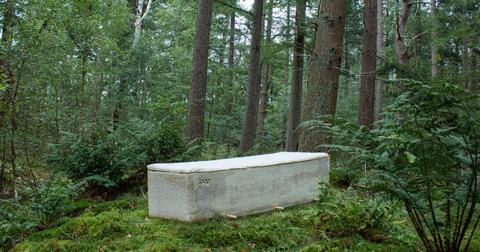
Some things seem dead simple and yet so difficult to achieve. How we do burials and dispose of our dead bodies used to be a no dramas affair, with families burying their loved ones remains in the backyard or the church grounds or a community grave yard.
That was in the good ole days. Not so now, with rules and regulations making disposal of our bodies a multi-million dollar business that many people seem very willing to oil with their hard earned dollars. All in the name of having a good send off, as if the dead person has any idea about what’s going on, other than perhaps being told beforehand or even making plans for such extravagance.
That said, there are a few people who are not conforming to the current ways, choosing to tread their own path. This story by Sophie Hirsh: Mushroom Based Coffin Asks Humans: Are you waste or compost? (Green Matters, September 2020).
Wooden coffins? That trend is so dead.
With a goal of making the human burial — and decomposition — process more environmentally-friendly, a company has invented the Living Cocoon, a coffin made from mushrooms that returns the deceased to the earth while enriching it.
Invented by Delft University of Technology researcher Bob Hendrikx and his Netherlands-based company Loop, the Living Cocoon (aka the Loop Cocoon) claims to be the first “living coffin” on Earth. Loop makes the cocoon out of mycelium, a living fungus that naturally grows underground amongst the roots of trees, plants, and fungi. Not only is mycelium biodegradable, but it also has a few special powers — it provides nutrients to the plants growing around it, it can neutralize toxic substances, and it can clean up soil by converting waste products into nutrients.
When buried in a traditional coffin, human bodies typically take at least 10 years to break down. The Living Cocoon typically composts and disappears in just 30 to 45 days, and the body inside breaks down in two to three years.
Some conventional glossy finished coffin burials, which pollute the soil due to the chemicals used to preserve the body along with other non-biodegradable materials, is in stark contrast to the Living Cocoon, which actually provides nutrients to the surrounding soil.
Read the full story here: https://www.greenmatters.com/p/mushroom-coffin
Another story along the same lines on 15 Sept in The Guardian, here: https://www.theguardian.com/society/2020/sep/15/first-funeral-living-coffin-made-mushroom-fibre-netherlands


 Die-alogue Cafe