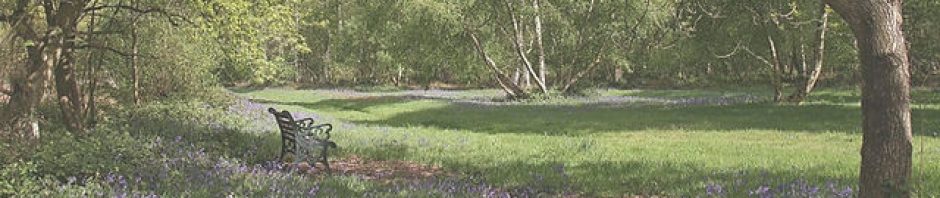
It’s long been known that when times are hard and nothing seems to be going right, getting into the bush or some other nature space can work wonders on the mind and help us sort out our worries – to rebalance the brain and bring us some sense of normality.
In these extracts from a book by Indira Naidoo, we have tried to capture the essence of how she recovered from the tragic death of one of her sisters.

The Space Between The Stars, by Indira Naidoo, 2022
Ch 6 – Tree of Life
Parts of my urban backyard have relished the rain. Beyond the naval fleet across Woolloomooloo Bay – Sydney’s Royal Botanic Gardens is bursting with vigour. The grassy slopes are a vibrant green and the trees seem to have expanded from the deluge.
Why does seeing that wedge of green wildness make my battered heart soar so? Many others are fascinated by this question. One of the books keeping me company on my morning walks has been Healing Spaced: The Science of Place and Well-being, by American neuro-immunologist Dr Esther Sternberg. She believes the restorative impact of nature has much to do with the colour green itself. Our yellow-green vision was the first to evolve. Green sits roughly in the middle of the light spectrum, not at the edges, making it more relaxing for our brain to process the visual information.
(Indira has adopted a fig tree – so much so that she writes ‘the tree has become mine.’)
Just seeing my tree again makes me feel immediately nourished.
Dr Sternberg says this soothing reaction isn’t unique to me but is an example of biophilia at work. Biophilia is a term popularized by American biologist E.O.Wilson in the 1980s to explain our innate need to connect with the natural world. But as far back as Aristotle, thinkers and philosophers have noted our affinity with living systems and the happiness they bring us. Sunlight, fresh air, forests, flowers, birdsong, beaches – isn’t that what we dream of escaping to when we’re trapped in our fluorescent-lit, air-conditioned office towers? No one daydreams about pitching a tent in the middle of an expressway. Pages 39-41.
…. Not only does a tree look after itself, but it is a refuge for other creatures – possums, spiders, birds, insects – perhaps a human or two without a bed for the night. A community Airbnb.
When it comes to surviving, trees have hot it all over us.
I want to learn to be more like a tree. Strong. Resilient, Permanent. Page 42
Someone who knows a lot about trees is Royal Botanic Gardens horticulturalist Paul Nicholson, who runs the Gardens’ volunteer and visitor programs, but this quote on his bio page, abut why he loves his job intrigues me. [I like] helping people understand that plants are central to their lives, that plants are interesting, exciting, engaging and the more time you spend with plants the happier you are likely to be. Page 43.
[The gardens] was a sacred site for Indigenous tribes, an initiation site or bora ground, and now it’s a spiritual meeting place for modern day Sydneyshiders. Even though there are more than 25,000 plants on these 30 hectares, it’s the tree elders that link the past to the present. They are the time travelers. Page 45.
Ch 8 – Birds of a Feather
When I take my walk and I’m with my tree, there are no disturbing sounds or sudden visual jolts. No drilling or droning, grinding or grating. Time passes in soothing waves of serenity The light is filtered, souncs are subdued: the tranquility of green silence pervades everything, as British nature writer Robert Macfarlane so perfectly describes it. Page 57
[Within the Gardens] the Summer is lazily unwinding into autumn. Piles of papery brown leaves from the plane tree carpet the pavement ….
The way they pirouette in the wind with such playfulness and vitality it’s almost impossible to view them as no longer alive. But that is technically what they are. Departed, Expired, Deceased.
… the leaves may be dead, but I’m beginning to understand more deeply the nanturaliness in their passing. They’ll decompose and nourish more life. The branches of the plane tree above me will soon be sprouting new green shoots, eager to take their place in the continuum.
….. Eventually everything must return to the earth. I’m seeing that more clearly now. Death doesn’t have to be a rip in the universe.
It’s something reinforced in the insightful wirtings of English psychiatrist and psychotherapist Sue Stuart-Smith. Her book The Well Gardened Mind is bobbing along in my canvas shoulder bag.
…. Being in nature reminds her of the continuity of life and how our day-to-day lives are part of the cycle of death. But she warns: If we think about dying too much it interferes with living, but if we never think about death, we remain seriously unprepared.
Urban nature is constantly giving us clues to this life-and-death cycle with the ephemera it scatters across our path. It’s not only trees and plants that shed parts of themselves. Birds are discarding their plumage constantly.
[A feather on the footpath should be a reminder of something more than waste to be swept aside] They are glorious sculptures of keratin that enable birds to ride the winds in any direction while keeping them warm and dry and protected. Pages 64 and 65

Chapter 10 – On a Wing and a Prayer
There’s actually a birdwatching term for returning to the same palce agains and again to identify and study the birds in the area. It’s known as atlassing – and in a way, I imagine my regular visit to my tree have been a form of atlassing. I’m discovering that the world of birdwatching is a mysterious one. The terminology alone can be bewildering.
I’m apparently a dude – a birdwatcher who doesn’t know much about birds. A stringer is someone who incorrectly records sightings of birds. And a twitcher is a birdwatcher preopared to travel great distances to see a rare bird and cross it off their bucket list. To dip is to miss out on seeing a bird you are looking for. And to grip is to see a bird another birder has missed and to tell them you’ve seen it. (This sounds more like gloating to me.) page 79.
[ Steve Abbott is a bird observer and ABC Radio program producer. Like Indira he has experienced grief from the death of loved one.] Steve shares stories of his own grief when his mother died, and reassures me that the old cliché that time heals is indeed true but true but the wait can be agonizing. Page 82.
Steve’s interest in birds led to a ten-part documentary series for ABC Radio called Bird Brain, ( reference:
https://www.abc.net.au/local/sites/birdbrain/ ) where he delved deeper into this secret world.
Even in death the ties are strong for birds. Steve once witnessed an extraordinary scene on his suburban street in Bondi. A magpie had been killed by a passing car and its body lay stiff and lifeless in the middle of the road. Several other magpies had gathered round the body, staring with heads bowed – a phenomenon ornithologists refer to as a bird roadside funeral. Steve says observe wild birds mourning the death of another in this way was one of his most sorrowful encounters. Do birds experience grief the way humans do? The jury is out on that one, say the researchers. What seems like displays of maternal or kinship mourning may simply be confusion. Pages 84 and 85.
Chapter 12 – Weeds in the Cracks
[ Diego Bonetto is of Italian heritage with a love of wild plants especially what we refer to as weeks.]
Being oblivious to the weeds along the paths where we walk, is what Diego calls plant blindness. He says the foraging classes he conducts through the suburbs and along coastlines are important because once you know the name of a plant or tree you can no longer ignore it. Give something a name and it will always demand to be seen.
Even the majestic plane trees above us have value beyond their shade. Their sap can be tapped for a syrup similar to maple syrup. Pharmaceutically, plane trees are medicine cabinets. Some people boil the bark in vinegar for the treatment of toothache and diarrhoea. Their leaves may also be bruised and applied to the eyes to treat conjunctivitis and other inflammations.
Another plant, this time one referred as an invasive species is called the madeira, a South American émigré classed as a highly invasice weed that is choking native vegetation all along Australia’s subtropical coast. Diego explains it’s a hardy perennial that enjoys scaling trees and then hanging in wide curtains of heart shaped leaves and flowers. What many disparaging articles won’t tell you is that it also edible. It’s eaten extensively in Japan, according to wild food and permaculture expert Kirsten Bradley from Miikwood. It’s known as okawakame or land seaweed. It’s bright green leaves are used like a spinach in stir-fries, and the vine’s roots can be baked like potatoes.
Why not harvest and cook them? Diego asks. Pages 99 – 100
Chickweed and Fat hen are also useful weeds that can be harvested, says Diego.
The domain of many weeds may be within the cracks, but cracks are where the light gets in. Pages 101 – 103
Chapter 13 – Peas in a Pod
[Indira was one of a closely knit sister threesome. But the three became two when one of her sisters took her own life.]
How did a plum tree in a Melbourne suburban backyard almost fifty years later become a makeshift gallows for the brightest star in our trio? This plum tree, a symbol of life and strength and protection, was coopted into the most horrific of roles.
My fig tree has been giving me back my life; Stargirl used a plum tree to take away hers.
As Stargirl climbed into its branches, the night air dank and brooding, and slipped the chain around her neck, the only witness to her final precious moments was this tree. A silent sentinel that could not move, that could not scream.
The arborist comes the week after Stargirl’s death to remove the tree. It’s a punishment for being in the wrong place at the wrong time. Its black trunk and purple leaves are all that remain of the dark grisly deed that transpired under its branches. The arborist has seen this tragedy played out many time. He has had to remove many trees like this, trees used in this way by the agonized and tormented. Tress removed in the hope of erasing the awfulness of the memory. He knows it never works. Pages 109 – 110


 Die-alogue Cafe